

How to Run a Klaviyo Account Audit: What to Look For (And What Most Brands Miss)
Most brands doing $1M+ in revenue think their Klaviyo account is set up. It's usually not. It's just running.
There's a welcome flow, maybe an abandoned cart, campaigns going out semi-regularly. The gaps are in the flows built once and never touched again, the segments that no longer reflect customer behavior, the deliverability settings skipped during setup, and the attribution window quietly misrepresenting what email is actually doing for the business.
A Klaviyo account audit is a systematic review of your flows, segments, campaigns, deliverability, and revenue attribution to surface what's underperforming and why. Done properly, it tells you exactly where you're leaking revenue and what to fix first. This is what that looks like in practice.
What Is a Klaviyo Account Audit?
"Set up" and "optimized" are not the same thing. A flow built 18 months ago and never touched isn't working for you. It's just running. A segment created during onboarding may no longer reflect how your customers actually behave. An abandoned cart sequence with a single email is leaving recovery revenue on the table every day. An audit closes the gap between running and performing.
Run one in these situations:
Email revenue has plateaued or dropped
You're about to scale ad spend and want retention solid first
You're onboarding a new agency or hire
It's been more than six months since anyone looked closely at the account
You just had a major product launch or sales event and want to understand what worked
The minimum recommendation: every six months. More frequently if your list is growing quickly or you're running high send volumes.
The 6 Areas to Audit in Your Klaviyo Account
1. Your Core Email Flows
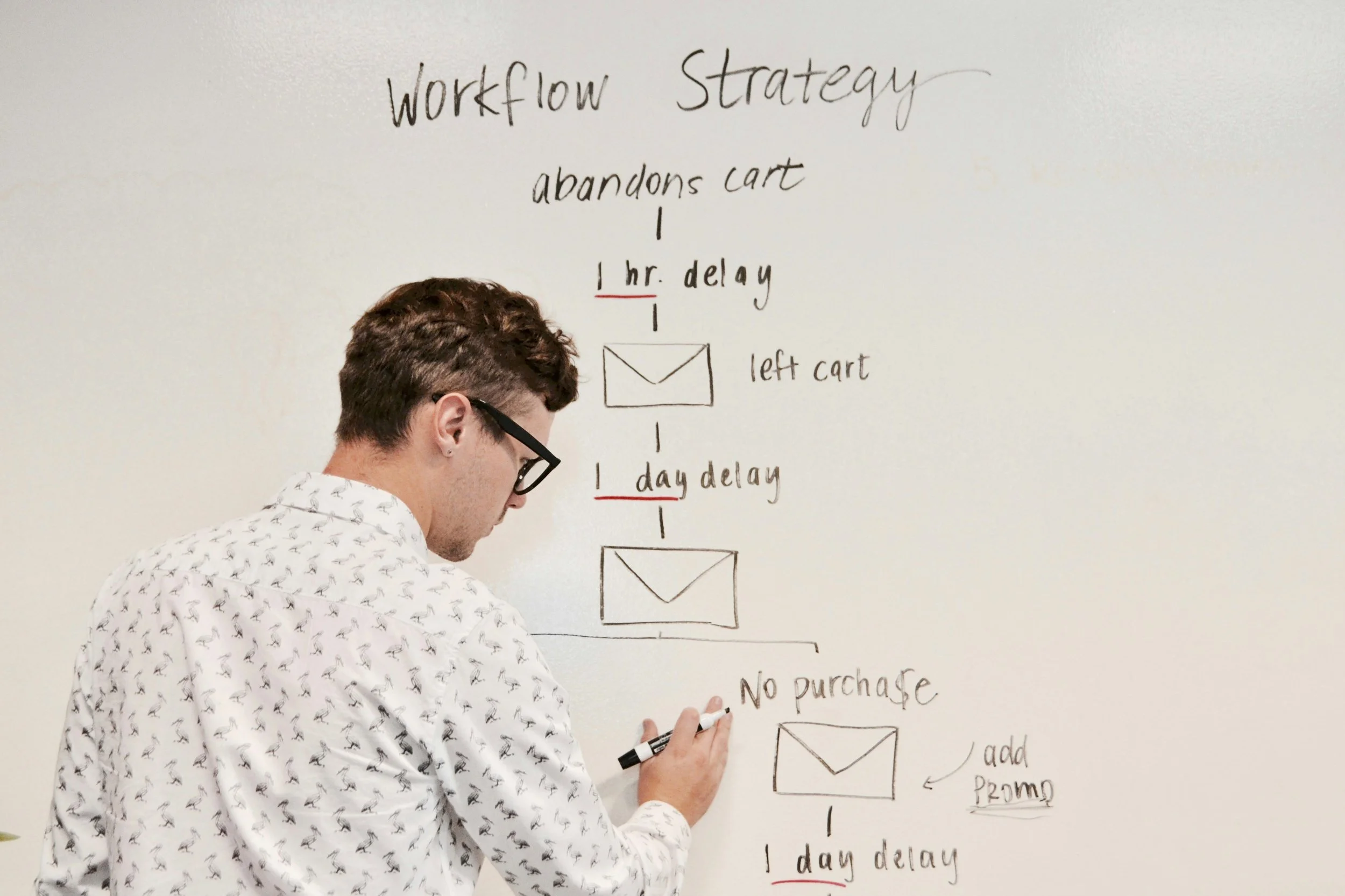
Flows are where the real money lives. According to Klaviyo's 2026 Benchmark Report, automated flows generate nearly 41% of total email revenue from just 5.3% of sends, with average revenue per recipient nearly 18 times higher than campaigns. If your flows are underbuilt, you are leaving a significant amount of money behind.
Every account should have these active:
Welcome series
Abandoned cart flow (multi-step, not one email)
Browse abandonment flow
Post-purchase flow
Win-back flow (60/90/120-day lapsed logic)
Sunset/suppression flow
For each active flow, check the following:
Revenue per recipient (RPR): This is the number that tells you whether a flow is actually working. A welcome series with an RPR of $0.50 has room to grow. Top performers hit $7 to $8 RPR on their welcome flow alone.
Conversion rate: Is the flow driving purchases, not just opens?
Last edited date: A flow not touched in 12+ months has not been optimized. Products change, pricing changes, brand voice evolves. The flow does not know that.
Conditional splits: Is every subscriber getting the same content regardless of purchase history and behavior? That is a missed personalization opportunity at scale.
Nearly 48% of flow-driven email revenue comes from new buyers, per Klaviyo's 2026 data. Your welcome and abandonment flows are not just retention tools. They are first-purchase conversion tools.
The most common red flag we see: the welcome flow doing all the heavy lifting, and then silence after the first purchase. That silence is expensive.
2. Segmentation and List Health
Klaviyo's research shows brands doing $1M–$10M average around 44 active segments. Brands doing $10M+ average over 130. That gap is not coincidence. More precise segmentation directly correlates with higher revenue per recipient.
At minimum, your account should have:
An engaged segment (opened or clicked in the last 90–180 days)
An unengaged segment suppressed from main campaign sends
A VIP/top purchaser segment
A first-time buyer segment
A lapsed customer segment for win-back
If every campaign goes to your full list, you are actively damaging your sender reputation. Unengaged subscribers who repeatedly ignore your emails signal to inbox providers that your emails are not wanted. Over time, that degrades inbox placement for everyone on your list, including the subscribers who do want to hear from you.
Also check for suppressed profiles, duplicates, and hard bounces. These inflate your list size and skew every performance metric you are looking at. A list that looks like 50,000 subscribers but has 12,000 hard bounces, duplicates, and unengaged contacts in it is not a 50,000-person asset.
List hygiene is not a one-time task. Build it into your regular routine: review suppressed and bounced profiles every quarter, and run a re-engagement or sunset campaign for anyone who has not engaged in 180+ days before you suppress them permanently.
3. Campaign Strategy and Send Cadence
Pull your campaign report for the last 90 days and look at click rate, revenue per recipient, and placed order rate. Not open rate. More on that in the attribution section.
What to look for:
Are campaigns going to your engaged segment or your full list? Full-list sends made sense when segmentation was hard. It is not hard in Klaviyo.
Is the content mix varied, or is it almost entirely promotional? Brands that only show up with discounts train their list to wait for them.
Is send cadence consistent, or only active around sales events?
Are you A/B testing subject lines, content, or send timing? If not, every campaign is a missed optimization.
Sending to your full list without filtering for engagement is also a deliverability risk, not just a personalization miss. Unengaged subscribers who repeatedly ignore your emails signal to inbox providers that your emails are not wanted. Over time, that degrades inbox placement for everyone on your list, including the subscribers who do want to hear from you.
If click rate is low despite high open rates, you do not have a subject line problem. You have a content or offer problem.
4. Email Deliverability

Deliverability problems are invisible in your Klaviyo dashboard until they become catastrophic. By the time revenue drops, the damage to your sender reputation may be months old.
Benchmarks to check:
Spam complaint rate: Stay below 0.1%. Above 0.3% and you risk being blocklisted. That is three complaints per 1,000 emails.
Hard bounce rate: Below 0.5%.
Unsubscribe rate: Below 0.2% per send. Consistent spikes point to a segmentation or relevance issue.
Also verify SPF, DKIM, and DMARC are configured for your sending domain. As of February 2024, Google and Yahoo mandated these for all bulk senders. Microsoft followed in May 2025. Fully authenticated senders are 2.7 times more likely to reach the inbox and achieve placement rates of 95–98%, versus a global average of around 85%.
Check that DMARC is set to an enforcement policy (quarantine or reject), not just monitoring (p=none). A surprising number of accounts have DMARC in monitoring mode only, which does nothing to build inbox provider trust.
One more thing worth checking: your dedicated sending domain. If you are still sending from a shared domain, you are sharing a sender reputation with every other brand on that infrastructure. Setting up a dedicated sending domain in Klaviyo is a straightforward change with a meaningful impact on deliverability over time.
5. Revenue Attribution and Reporting
Klaviyo states that email should drive at least 30% of B2C revenue. Healthy programs in our experience sit in the 20–40% range. If you are under 20%, the audit will almost always show you why: underbuilt flows, poor segmentation, inconsistent campaigns, or some combination of the three.
Track flow revenue and campaign revenue separately. In a well-functioning program, flows should generate 15–20% of total revenue on their own at a minimum. If almost all email revenue is coming from campaigns, your automation stack is not doing its job and your revenue stops the moment you stop sending.
Open rate is the wrong metric. Apple's Mail Privacy Protection inflated open rates for everyone in late 2021. Apple Mail now accounts for roughly 50% of all email opens, meaning a significant portion of the "opens" in your account are machine-triggered, not human. We still see brands pausing campaigns and sunsetting segments based on open rate data alone. That is the wrong input.
The numbers to anchor to: click rate, revenue per recipient, and placed order rate. These tell you whether email is actually converting, not just whether people are opening.
Also check your attribution window. Klaviyo defaults to five days, but the right window depends on your product and purchase cycle. A brand with a longer consideration cycle should be looking at a wider window. A brand with impulse-driven products might want a shorter one. An incorrect attribution window means your revenue data is either overstating or understating what email is actually responsible for, and every decision you make from that data is built on a shaky foundation.
6. Integrations and Tech Stack
Check every integration, not just whether it is connected but whether it is actually doing what you think it is doing.
Shopify sync: Is it active and real-time? Are customer events (placed order, fulfilled order, cancelled order) flowing correctly into Klaviyo?
Review apps (JudgeMe, Okendo, Zest): Is a review request flow live and timed correctly post-delivery? Are review events flowing into Klaviyo as properties you can segment on?
SMS (Attentive): Are email and SMS flows coordinated or running in parallel to the same people at the same time? A customer getting an abandoned cart email and an SMS within the same hour is over-messaged. A customer getting neither because of a sync issue is a missed opportunity.
A connected integration that is not actively informing flows or segmentation is just noise in your account. The audit question is not just "is it connected" but "what is this integration actually doing for the email program?"
Klaviyo Audit Checklist
Use this as your starting point. It covers the areas where we most consistently find gaps. Every account has its own quirks, but if everything on this list is in order, you are in a strong position.
Flows
Welcome, abandoned cart, browse abandonment, post-purchase, win-back, and sunset flows all active
All flows edited within the last 6 months
Conditional splits present in key flows
Abandoned cart is a multi-step sequence, not a single email
Segmentation
Engaged, unengaged, VIP, first-time buyer, and lapsed segments built
Campaigns defaulting to engaged segment, not full list
Hard bounces and suppressed profiles cleaned
Deliverability
SPF, DKIM, DMARC configured and DMARC set to enforcement policy
Dedicated sending domain set up
Spam complaint rate below 0.1%, bounce rate below 0.5%
Attribution and Reporting
Attribution window set correctly for your business model
Flow and campaign revenue tracked separately
Email percentage of total revenue benchmarked against 20–40% target
Decisions being made from click rate and RPR, not open rate
Integrations
Shopify sync active and real-time
Review app integration active with a live review request flow
SMS and email flows coordinated, not competing
What to Do With What You Find
Fix revenue leaks first: missing core flows, authentication issues, campaigns going to the full list without engagement filtering, spam complaint rate above benchmark. These are not optimization problems. They are structural problems and they compound over time.
Then address the structural gaps: single-email sequences that should be multi-step, missing segmentation, integrations connected but not actively used in flows. These take longer to implement and longer to see results from, but they are what move the 20–40% revenue benchmark.
Ongoing from there: A/B testing flow and campaign content, refining conditional splits based on performance data, expanding the content calendar beyond promotional sends.
Give changes 60–90 days before drawing conclusions. Flow changes show results faster since flows run continuously, but campaign changes need enough sends to be statistically meaningful. If you've rebuilt your welcome series and it's been two weeks, you do not have enough data yet.
How Often Should You Audit Your Klaviyo Account?
Every six months minimum. Also run one:
After any major Klaviyo platform update
After a major sales event (BFCM, product launch)
When onboarding an agency or new hire
When email revenue drops unexpectedly
The brands that perform consistently on email are not the ones who built a great setup once. They are the ones who keep looking at it. A Klaviyo account is not a set-it-and-forget-it system. Platform updates change how features behave. Customer behavior shifts. New flows become possible. What was best practice 12 months ago may have a better approach today.
Build the audit into your calendar the same way you would a quarterly business review. It does not need to be a full agency engagement every time. Even a focused internal review of the six areas in this guide will surface something worth fixing.
Questions to Ask a Klaviyo Agency Before You Hire
If you are considering bringing in an agency to manage or overhaul your Klaviyo account, the audit conversation is a useful filter. How an agency talks about the first 30 days tells you a lot about how they actually work. Here are the questions worth asking.
"What do you look at in the first 30 days before you change anything?" A good agency audits before they build. If the answer is "we start building flows right away," that is a flag.
"How do you measure the performance of an email program?" If they lead with open rates, press them. The right answer involves RPR, click rate, email's share of total revenue, and flow versus campaign split.
"What's your process for reviewing deliverability?" If deliverability is not part of their onboarding audit, that is a gap.
"Can you walk me through how you'd audit this specific account?" Vague answers tell you less than specific ones.
Red flags that tell you they have not actually been in many accounts:
They lead with open rates as a primary performance metric without acknowledging Apple MPP
They do not ask about your current tech stack (review apps, loyalty, SMS) before proposing a scope
Their case studies only show campaign metrics, not flow revenue
They cannot tell you what a healthy RPR benchmark looks like for your vertical
These are not trick questions. They are what you would expect someone who works inside Klaviyo accounts every day to know.
Ready for a Second Set of Eyes on Your Klaviyo Account?
We are Klaviyo Growth Partners. Auditing accounts and fixing what we find is a core part of how we work with every client we bring on. We work with D2C brands doing $1M+ in revenue across food and beverage, health, beauty, skincare, and fashion, and we go deep on Klaviyo, Attentive, and the full retention stack.
If your Klaviyo account has not been reviewed in the last six months, or if email is not pulling the revenue share it should be, we will take a look. No generic recommendations, just a real assessment of what is in your account and what to do about it.
We do free Klaviyo account audits for D2C brands in our verticals. If that is you, reach out.