
Klaviyo vs. Attentive: Which SMS Platform Is Right for Your D2C Brand?
At some point in your email program's life, someone asks the question: "Should we be doing SMS too?" The answer is almost always yes. SMS now reaches over 7 billion people globally, and in ecommerce, it's gone from a nice-to-have to a genuine revenue channel. Klaviyo's own benchmark data shows SMS driving an average of $0.11–$0.25 revenue per recipient on campaigns for D2C brands, which compounds fast once your list has scale. The harder question is what platform to run it on, especially if you're already on Klaviyo for email.

Klaviyo has built out its own SMS product. Attentive launched as an SMS-first platform and has stayed focused there. Both are legitimate options. Both have real strengths. And depending on where your brand is and how SMS fits into your overall retention strategy, the right answer genuinely varies.
We use both at Strategy Maven Agency: Klaviyo for email and increasingly for combined email + SMS programs, Attentive for brands where SMS is a primary revenue channel. This isn't a hit piece on either platform. It's what we actually think, based on what we've seen across client accounts.
QUICK ANSWER Klaviyo is the better call if you want email and SMS managed in one place: unified data, shared flows, and less operational overhead. Attentive wins if SMS is a primary channel and you need best-in-class list growth, conversational messaging, and dedicated SMS tooling. The right choice comes down to where SMS sits in your retention stack right now.
First, What Does Each Platform Actually Do?
It's worth being clear on what you're comparing, because these two products started from very different places.
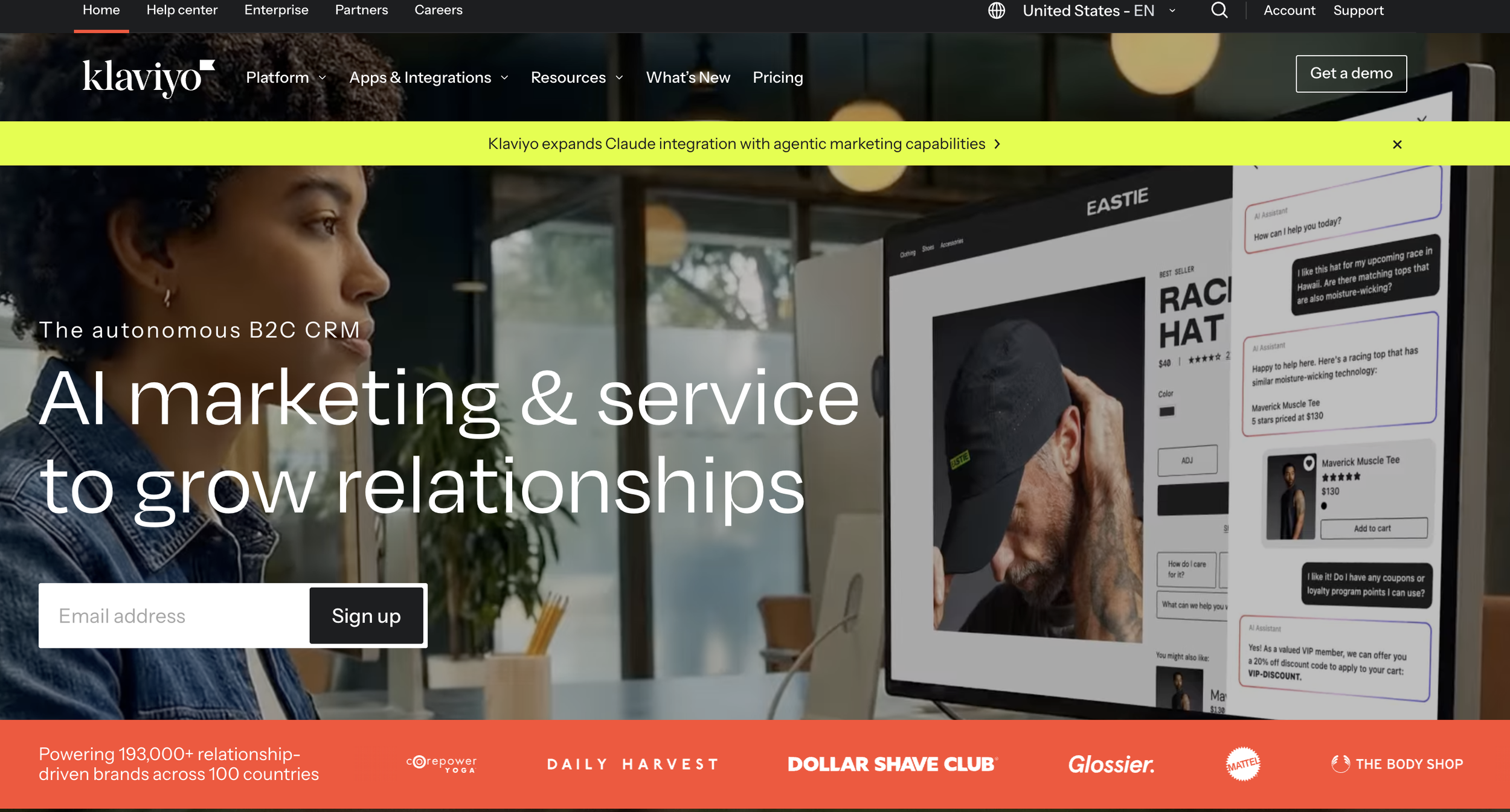
Klaviyo is fundamentally an email marketing platform that added SMS. It's built around a unified customer data profile: one place where all your behavioral data, purchase history, and engagement signals live, used to power both email and SMS flows, segments, and campaigns. If you're running email on Klaviyo and want to add SMS, it lives inside the same platform, the same flows, the same segmentation logic.
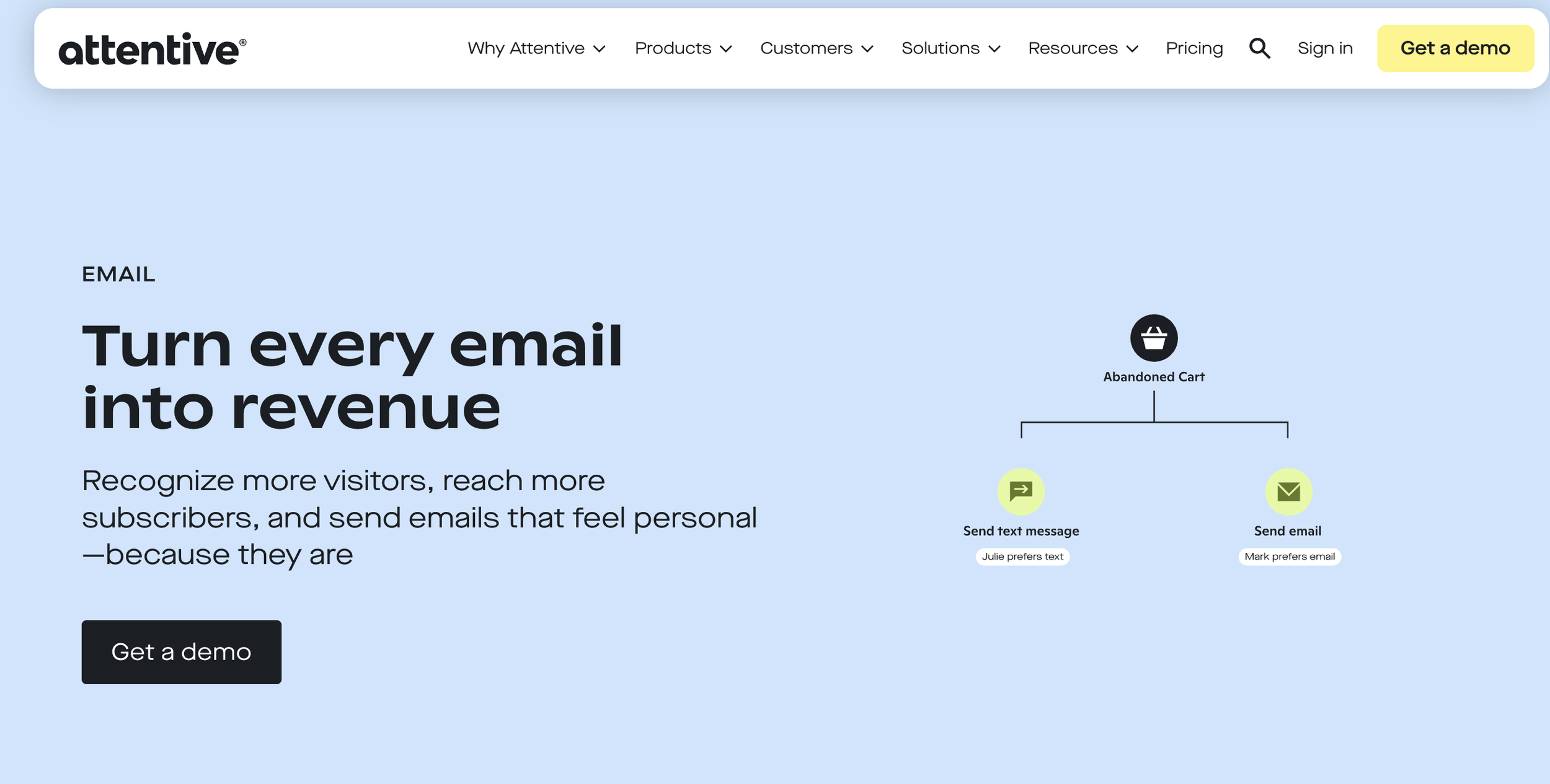
Attentive was built SMS-first and has stayed there. Its core product is built around list growth, high-converting opt-in units, and two-way conversational messaging. It has email features now, but SMS is where the depth lives: the AI send-time optimization, the subscriber conversation tools, the dedicated compliance infrastructure.
Neither platform is trying to be something it isn't. The decision is about which architecture fits your business better.
Where Klaviyo SMS Wins
Unified Data and Segmentation
This is the biggest practical advantage of running SMS through Klaviyo: everything lives in one place. Your email subscriber is the same profile as your SMS subscriber. Suppression lists, engagement data, purchase history, flow triggers — all of it operates from a single source of truth. When you want to build a win-back sequence that reaches lapsed customers first by email, then by SMS if they don't engage, that's straightforward in Klaviyo. On separate platforms, you're syncing data between tools and hoping nothing falls through.
The cross-channel payoff is real: Klaviyo's benchmark data shows that brands using both email and SMS flows generate 15–20% more revenue per recipient than those using email alone.
Flow Logic and Cross-Channel Automation
If you're already fluent in Klaviyo flows — and if you've been running email for any length of time, you should be — adding SMS to those flows is a low-lift win. You can add SMS steps into your abandoned cart flow, your post-purchase sequence, your win-back series, without rebuilding anything from scratch. The conditional logic, the timing, the branching all work the same way. That operational continuity is genuinely valuable, especially for lean teams.
And the channel itself pulls its weight: Attentive reports that the average SMS message is read within 90 seconds of delivery, compared to 90 minutes for email.

The Right Fit for Earlier-Stage SMS Programs
For brands where SMS is a secondary channel, supporting email rather than leading it, Klaviyo is usually the smarter call. You get 80–90% of what you need without the complexity and cost of a dedicated SMS platform layered on top of your email tool. We've seen brands add SMS through Klaviyo and start driving meaningful incremental revenue within a few months, without adding operational overhead they couldn't manage.
Lower Barrier if You're Already on Klaviyo
There's a practical reality here: if your team is already in Klaviyo every day, adding SMS to that workflow is a much smaller ask than onboarding an entirely separate platform. Training, login management, billing consolidation, reporting — all of that gets simpler when it's one tool. For a lot of brands, that simplicity is worth more than a feature they're not going to use for six months anyway.
WORTH KNOWING We're Klaviyo Growth Partners, which means we go deep on the platform and stay current on every update. Klaviyo's SMS product has improved significantly over the last couple of years. It's not the afterthought it used to be. For most brands doing $1M+ in revenue with SMS as a supporting channel, it's more than capable.
Where Attentive Wins
List Growth Is Attentive's Superpower
If your SMS list is small and building it is the priority, Attentive has a real edge. Their two-tap mobile opt-in is genuinely better than what Klaviyo offers for list acquisition: faster for the subscriber, higher conversion, and more creative flexibility in how you deploy sign-up units across your site. Attentive reports that 61% of US consumers have bought something between $50 and $500 after receiving a text about it. For brands in categories like beauty, skincare, and food & beverage where SMS subscribers tend to be high-intent and high-LTV, investing in a better list can have a compounding return over time.
Two-Way Conversational Messaging
Attentive has built real infrastructure for two-way SMS conversations — the kind where a subscriber texts back and a human (or an AI-assisted human) can actually respond. This isn't widely used at every price point, but for certain brands in health, wellness, and food categories where customer questions before purchase are common, it's a meaningful differentiator.
The underlying behavior supports it: Attentive's Consumer Texting Behavior Report found that 91% of consumers who opt into brand SMS say they find the messages useful — which is the more honest signal of engagement quality.
AI-Driven Send Optimization
Attentive's AI product for SMS covers send-time optimization, predictive targeting, and message personalization, and it's more mature than what Klaviyo currently offers on the SMS side. If you're sending at volume and want machine learning to optimize delivery timing and content at the individual subscriber level, Attentive is ahead here. Attentive reports that brands using their AI send-time optimization have seen up to 23% higher click-through rates compared to standard scheduled sends. For brands with large, active SMS lists, that can translate into measurable lift in revenue per send.
For Brands Where SMS Is the Lead Channel
If SMS is driving more revenue than email, or if it's clearly the channel your customers prefer, Attentive's depth of tooling starts to justify the added platform complexity. Consumer preference data backs the investment: 58% of consumers say they've made a purchase as a direct result of receiving a text message from a brand. The dedicated product investment shows in Attentive's toolset. For a brand where SMS accounts for 30–40% of digital revenue, the difference between a good SMS tool and an excellent one is a real number on your P&L.
"The platform question is really a strategy question in disguise — it forces you to decide how seriously you're investing in SMS and where you want it to sit in your retention stack."
The Real Question: Unified Stack or Best-in-Class Tools?
Every platform debate eventually comes down to this: do you want one tool that does everything reasonably well, or multiple tools that each do their job exceptionally well? There's no universally right answer. It depends on your team's capacity, your budget, and how much of a delta actually exists between "good enough" and "best in class" for your situation.
Here's how we think about it by stage:
Lean toward Klaviyo when:
You're already running email on Klaviyo
SMS is new or secondary for your brand
You want one platform, one bill, one dashboard
Your team is small and operational simplicity matters
Lean toward Attentive when:
SMS is a primary or fast-growing revenue channel
List growth is an active priority
You need two-way conversational messaging
SMS justifies its own dedicated tooling investment
Running Both: What It Actually Looks Like
Some brands run Klaviyo for email and Attentive for SMS simultaneously. It's a legitimate setup — we work with clients who do this. But it comes with real overhead: keeping subscriber data synced between platforms, managing opt-outs and suppression lists in two places, making sure your email and SMS messaging don't conflict in timing or offer. If you go this route, you need clear rules for which platform owns what — and someone whose job it is to keep both in sync.
It works, but it's not a set-and-forget decision.
Side-by-Side: Key Differences at a Glance
Feature / Factor
Platform focus
Unified email + SMS data
Flow automation (cross-channel)
List growth tooling
Two-way messaging
AI / send-time optimization
Operational complexity
Klaviyo SMS
Email-first, SMS added
Native — one profile ✓
Strong — email + SMS in same flow✓
Functional
Limited
Developing
Low — one platform ✓
Attentive
SMS-first, purpose-built ✓
Requires integration / sync
SMS flows are robust; cross-channel requires integration
Best-in-class two-tap opt-in ✓
Native, well-developed ✓
More mature AI toolset ✓
Higher if running alongside separate email tool
Questions to Answer Before You Decide
Before you make a platform call, work through these. The answers will tell you more than any feature comparison chart.
Is SMS your primary channel or a supporting one? If it's primary, meaning you expect it to drive 20%+ of digital revenue, that changes the calculus on dedicated tooling.
Are you already on Klaviyo for email? If yes, the bar to add Klaviyo SMS is much lower. If not, the platform choice becomes more open.
How important is list growth right now? If your SMS list is small and growing it is the immediate priority, Attentive's opt-in tooling has a real advantage.
Do you have the bandwidth to manage two platforms? Be honest about this. A second platform means a second integration, second reporting layer, second billing relationship, and someone who owns keeping both in sync.
What does the pricing look like at your send volume? Both platforms charge on a per-message basis (with platform fees on top). Run the numbers at your actual list size and send frequency before comparing them on features alone.
Does your customer base respond to conversational SMS? If your category has high pre-purchase questions or strong community engagement, two-way messaging becomes more relevant, and Attentive handles it better.
How This Fits Into a Full Retention Stack
SMS doesn't exist in isolation. Whatever platform you choose, it has to work with the rest of your retention tooling — and that's where a lot of brands underestimate the platform decision. The economics of retention make the stakes clear: acquiring a new customer costs 5–7x more than retaining an existing one, and a 5% increase in retention rate can increase profitability by 25–95%. SMS is one of the most powerful tools in that retention stack — but only if it's connected properly to everything else.
Think about the post-purchase review request: does your SMS platform trigger cleanly off a Klaviyo flow, or does that require a separate integration? Think about your loyalty program: when a subscriber earns a reward, does the SMS trigger fire based on the same customer profile your email flows use? Think about your win-back sequence: when you're reaching out to lapsed customers at 60, 90, and 120 days, are email and SMS coordinated? Or is there a chance someone gets both a Klaviyo email and an Attentive SMS on the same day making slightly different offers?
We work across the full retention ecosystem: Klaviyo, Attentive, JudgeMe, Okendo, Zest, loyalty integrations. The brands with the cleanest programs are the ones who made their platform decision with the full stack in mind, not just the features of the SMS tool in isolation.
RETENTION STACK REALITY CHECK The most expensive retention mistake we see isn't choosing the wrong SMS platform. It's treating SMS, email, reviews, and loyalty as separate programs instead of a coordinated system. Platform choice matters — but stack design matters more.
Our Honest Take — After Using Both
For the majority of the D2C brands we work with — food & beverage, health, skincare, beauty, fashion, starting SMS on Klaviyo is the right move. Not because it's the most powerful SMS tool on the market, but because they're already on Klaviyo, their team is already fluent in it, and getting a coordinated email + SMS program running is more valuable than getting a slightly better opt-in conversion rate from a dedicated platform they'll struggle to manage.

The calculus shifts when SMS starts becoming a primary revenue driver — when a brand is actively building their SMS list as a strategic priority, when conversational messaging would genuinely change their customer experience, or when they've hit a ceiling on what Klaviyo's SMS product can do for them. That's when Attentive starts making real sense, and when the operational overhead of running two platforms is justified by the revenue upside. It's worth noting the trajectory: SMS has a click-to-purchase conversion rate nearly 3x higher than email for time-sensitive offers. — which means SMS as a purchase-driving channel is only going to get more important, not less.
What we'd push back on is the impulse to default to Attentive because it's the "dedicated SMS platform" and therefore must be better. Complexity has a cost. Managing two platforms takes real bandwidth. And a well-run Klaviyo SMS program will outperform a poorly-managed Attentive account every time. Platform choice is about 20% of the outcome. Setup, strategy, and ongoing optimization are the other 80%.
If you're unsure where you fall, the answer is usually: start with Klaviyo, do it properly, and revisit the platform question when you have the data to make it a real business decision rather than a speculative one.
The Bottom Line
Klaviyo and Attentive are both good platforms. The question isn't which one is objectively better — it's which one fits your situation. Klaviyo wins on operational simplicity and cross-channel coordination. Attentive wins on dedicated SMS depth, list growth, and conversational messaging. Most brands with SMS as a secondary channel are well-served by Klaviyo. Brands where SMS is a primary channel or a fast-scaling one should look seriously at Attentive — with clear eyes about what running two platforms actually requires.
Either way, the platform is a starting point. What you build on top of it — your flows, your segmentation, your send cadence, your offers — is where the real work is.
Frequently Asked Questions
What is the difference between Klaviyo and Attentive? Klaviyo is primarily an email marketing platform that added SMS, built around a unified customer data profile that powers both channels from one place. Attentive is an SMS-first platform built specifically for list growth, conversational messaging, and dedicated SMS automation. The core difference is architecture: Klaviyo prioritises cross-channel coordination, Attentive prioritises SMS depth.
Is Klaviyo good for SMS marketing? Yes, particularly for brands where SMS is a secondary channel supporting email. Klaviyo's SMS product has matured significantly and integrates natively with its email flows, segmentation, and customer data. For D2C brands already on Klaviyo for email, adding SMS through the same platform is operationally simpler and often more than sufficient.
Can you use Klaviyo and Attentive at the same time? Yes, and some brands do. The typical setup is Klaviyo handling email and Attentive handling SMS. It works, but it comes with real overhead: keeping subscriber data synced, managing suppression lists in two places, and making sure email and SMS messaging don't conflict in timing or offer. It requires a clear governance model and someone accountable for keeping the integration healthy.
Which SMS platform is best for D2C ecommerce brands? It depends on where SMS sits in your business. If SMS is a supporting channel and you're already on Klaviyo for email, Klaviyo SMS is usually the smarter call. If SMS is a primary or fast-growing revenue channel and you need best-in-class list growth, two-way messaging, or AI send optimisation, Attentive is worth the added complexity. Most D2C brands doing $1.5M–$5M in revenue start with Klaviyo and revisit the platform question as SMS scales.
Does Attentive integrate with Klaviyo? Attentive and Klaviyo can be run alongside each other, but they are separate platforms with separate data environments. Integrating them requires syncing subscriber data, suppression lists, and conversion events between the two. It's a manageable setup with the right operational model, but it's not a native integration — it requires ongoing maintenance to keep both platforms aligned.
How much does SMS marketing cost on Klaviyo vs. Attentive? Both platforms charge on a per-message basis, with additional platform or seat fees on top. The exact cost depends on your list size, send frequency, and the plan you're on. Because pricing changes frequently and varies by usage, the best approach is to request a quote from each platform based on your actual send volume, then compare that against the feature delta relevant to your stage. Don't compare on features alone without running the numbers at your real usage.
When should a D2C brand switch from Klaviyo SMS to Attentive? The inflection point is usually when SMS becomes a primary revenue driver — when it's accounting for a significant share of digital revenue, when list growth becomes an active strategic priority, or when you've hit a ceiling on what Klaviyo's SMS tooling can do for your program. If you're at a stage where the difference between good and excellent SMS tooling translates to a real revenue number, that's when Attentive's dedicated feature set justifies the added platform complexity.
Not sure which setup is right for your brand?
We do free Klaviyo account audits for D2C brands in food & beverage, health, beauty, skincare, and fashion. If your SMS program is underbuilt — or if you're not sure whether you're on the right platform — let's take a look together.